
Diploma programme
Training:
Frequently Asked Questions
Find answers to all your questions about hypnotherapy training and how to train to be a hypnotherapist. Topics covered include our unique approach, course format, payments and booking, and questions about accreditation, how to become a hypnotherapist, and much more.
Can’t find the information you’re looking for? Email us at enquiries@hypno-cbt.com.
Questions about our approach
Hypno-CBT® College has always adopted a cognitive-behavioural approach to hypnotherapy. That means we draw mainly upon modern research on hypnosis that emphasises the role of cognition and other ordinary psychological factors in determining responses to hypnosis. We also draw upon elements of cognitive-behavioural therapy (CBT) as this, unsurprisingly, is the therapeutic approach most compatible with the cognitive-behavioural model of hypnosis.
When you train to be a hypnotherapist you will find it very grounding and confidence-building to know that what you are learning is based on extensive experimental and clinical research.
You can read more about our approach here: What is Hypno-CBT®?
It means we do our best to base our teaching upon a critical reading of contemporary research published independently in the main scientific journals of the hypnosis field, such as the International Journal for Clinical & Experimental Hypnosis (IJCEH). We also draw upon recognised empirically-supported treatments (ESTs), such as CBT, and integrate elements of these approaches with hypnotherapy.
Likewise, our courses explicitly refer to various modern textbooks which present a credible evidence-based approach, such as Essentials of Clinical Hypnosis: An Evidence-Based Approach (2006) by Lynn and Kirsch.
If you are looking to switch careers by training to be a hypnotherapist, then an approach that is strongly evidence-based will give you a solid grounding and confidence right from the start.
If you’re already a psychotherapist or have a degree in psychology, then you know how important it is to have an evidence-base for your approach and techniques.
Cognitive-behavioural hypnotherapy is a modality of hypnotherapy and not classed as a full CBT training. Both approaches share similar theories and concepts and therefore complement each other well. Cognitive-behavioural hypnotherapy also assimilates certain evidence-based techniques from CBT. Similarly, another major modality of hypnotherapy, “hypno-analysis”, draws upon theories, concepts, and techniques from psychoanalysis. However, this is a hypnotherapy diploma and not a full CBT practitioner training, so you cannot call yourself a Cognitive Behavioural Therapist after this training (you will be able to call yourself a Cognitive Behavioural Hypnotherapist). You will, nevertheless, learn a lot about CBT and “the cognitive behavioural approach” to psychotherapy during the training.
We teach CBT techniques alongside mindfulness, relaxation and hypnosis, which will enable a student to work competently with sub-clinical and milder issues, building up to working with more moderate or severe issues with experience, supervision and training.
We do cover CBT very well for a short training. We cover all the key CBT concepts and process aims, as well as a wide range of techniques based on the main learning theories in psychology (classical conditioning, operant conditioning, social learning, information processing).
Moreover, we teach more from CBT principles than a manualised approach. Thus, you learn the fundamentals of the CBT mindset and approach – and then how to be flexible and creative in designing treatment plans. We think that a focus on CBT fundamentals is the new direction that CBT is headed in.
We do not teach Ericksonian hypnotherapy. Our training has always adopted an evidence-based orientation and Ericksonian methods lack sufficient support from research on hypnotherapy. Our college is known for adopting a predominantly cognitive-behavioural orientation and “scientific” (or at least a semi-scientific) approach to teaching hypnotherapy. We hold as an ideal the “scientist-practitioner”.
In contrast, it is acknowledged by leading researchers that “…Ericksonians are clinicians who have little use for scientific facts.” (Weitzenhoffer, The Practice Of Hypnotism, p.593)
Moreover, some of the indirect and covert techniques of Ericksonian hypnotherapy, for example the idea of inducing hypnosis without the client being aware, would not be compatible with the fundamental collaborative principles of the client-therapist relationship in cognitive behavioural approaches.
We do not teach NLP techniques on the course. Despite the claims made for NLP there is a notable lack of evidence demonstrating the approach and techniques of NLP as effective. We believe that therapists have a duty to use the best interventions available and therefore we teach methods that have demonstrated reliable evidence of effectiveness.
We do not teach past-life regression on the course. Past-life regression is a “new age” technique and not normally considered part of mainstream clinical hypnotherapy. It is not included, for example, in the official National Occupational Standards for Hypnotherapy published by Skills for Health.
Our college adopts an evidence-based orientation and past-life regression lacks sufficient support from research to be considered part of this approach. Interestingly it is not a meditation, mental health or enlightenment practice in yoga, Hinduism or Buddhism, and it is deemed impossible to break through to memories of past lives until a very advanced level of spiritual development, just preceding enlightenment, has been attained.
Perhaps some of the most notable features of hypnosis are the vivid imaginary experiences that clients can experience, imagination that is experienced “as if real”. Indeed one of the leading researchers in hypnosis, T.R Sarbin, called hypnosis “believed-in-imaginings”. Experiences of past lives (or alien abductions) have been shown to be influenced by cultural beliefs (subjects from Canada recalled human past lives, subjects from South Korea recalled animal past lives).
Therefore, unless you are the Buddha, who just before his enlightenment was able to remember his past lives over 91 eons (each eon is the life of the solar system), it is likely that any “past life memories” induced under hypnosis are simply “believed-in-imaginings”. They may appear to be extremely vivid and with strong emotion attached, however this is a particular feature of the imagination during hypnosis.
The diploma focuses on teaching effective techniques for treating the widest range of problems and therefore mainly focuses on stress and anxiety, the most common presenting problem in hypnotherapy. In addition we cover pain control, goal setting, motivation, basic habit control, assertiveness and problem solving. We also run separate workshops on more specific topics which build upon the core skills learned during the diploma training.
Specific issues, such as smoking, weight loss and insomnia, require both detailed specialist knowledge AND require anxiety and stress aspects of those issues to be addressed. Thus the course focuses on teaching the core skills (treating/coping with anxiety and stress) that can then be used in a wide variety of presenting issues.
Many people who have taken other hypnotherapy training want to advance their knowledge with a more scientific approach, or find their original training was somewhat lacking and failed to give them the confidence to set up practice as a hypnotherapist.
We consistently receive feedback from those with prior hypnotherapy training that learning the evidence-based, cognitive behavioural model of hypnosis enabled them to feel confident in their hypnotherapy practice. They appreciate getting a really solid, clear, common-sense model of hypnosis and the wide range of techniques and approaches they learn on the course. In particular, those retraining in this approach love that they are on a solid evidence-base and that they learn a systematic way of approaching a wide range of presenting problems.
In many ways this is an “Advanced Hypnotherapy Training” – you learn the most up-to-date models of hypnosis and a huge range of evidence-based techniques, plus a deep theory and philosophy.
A recent graduate of the Diploma, Dr Jonathan Pointer, Chartered Psychotherapist and Psychologist, shared the following about the training programme:
“As a Chartered Clinical Psychologist, I highly recommend this course because I know it will deeply enhance an applied psychologist’s range of effective interventions across a wide variety of client issues.” — Dr Jonathan Pointer, https://therapysanctuary.com
There is so much research into hypnosis that it’s hard to know how to pull it together into a concise answer.
You can find the research into hypnotherapy by going to the National Library of Science — a US-based website that is the global library for biomedical research papers: https://pubmed.ncbi.nlm.nih.gov/?term=hypnotherapy — that search currently generates over 16,000 results. So we need to summarise that research!
The best place is to turn to a number of respected professional organisations that have published articles or reports about the efficacy of hypnotherapy.
Royal College of Psychiatrists
The Royal College of Psychiatrists have a helpful summary of the effectiveness of hypnotherapy on this page on their website:
“Research has shown that the following psychological conditions can be helped by hypnotherapy: post-traumatic stress disorder (PTSD), depression, anxiety, insomnia, eating disorders, functional disorders (bodily symptoms and conditions such as headaches, irritable bowel syndrome (IBS) or backaches which may have a significant psychological component), improving memory for people who have experienced a brain injury.
It has also been shown to help in the following medical conditions, often by reducing anxiety but also by reducing other symptoms: pain, medical and surgical procedures, cancer treatment side effects, anaesthetic procedures, burn wound care, dental procedures, childbirth, menopausal symptoms.
In addition, warts and other skin conditions can be improved by hypnotherapy. This is possible through the positive effects hypnosis has on the immune system. Hypnotherapy may also be effective for people who are trying to quit smoking or lose weight.”
Questions about the course format
Basically, our course is equivalent to a typical one-year hypnotherapy diploma but it’s compressed into intensive modules you can attend over consecutive days – the total number of classroom hours (135 classroom hours) is actually greater than on many “one-year” courses. Many course attendees prefer this concentrated way of learning.
If you choose to train to be a hypnotherapist you’ll find most hypnotherapy training courses require approximately 120-150 hours of classroom training. Our course runs “intensively” over three seven-day blocks, whereas other courses may require one or two days of attendance each month. We are required to meet the same standard of training, but we have chosen to do so in a shorter space of time because that format is more popular with students who do not wish to travel each month, or who want to complete their qualification without delays between each module.
We are also experienced in adult education and have been refining this training programme for over 15 years. It’s reasonable to state this is one of the most highly concentrated training programmes available.
See the video below for a clear explanation of how the training can be so compact.
You will have the status of ‘Student’ and access to all course materials for a period of 12 months from your access being activated. Your full 12 months’ access will allow you to revisit all videos and materials as often as you wish, for revision and familiarity.
Currently we have an intake start date on the 1st of each month. There are limited spaces on each intake.
Yes. Preparatory reading is not essential, although we do suggest that you read some material if you have time before the start of your course. The main textbook we suggest reading is the current edition (4th Edition) of Hartland’s Medical & Dental Hypnosis by Heap & Aravind.
(Note: the 3rd Edition is NOT suitable preparatory reading – this book was considerably re-written with the modern view on hypnosis in the 4th Edition).
That depends on your circumstances. If you are familiar with the subject already and feel confident that you’re able to keep up with the course then you can complete the stages of training close together, and train to be a hypnotherapist more quickly. Alternatively, if you feel that you need more time to digest the course material and do background reading then you may space the stages out more, e.g., over a period of 18 months. The training programme was specifically designed to allow complete flexibility in this regard to suit different students’ needs.
Probably 50% of students like to take the “fast-track” approach of completing the training course quickly (often within 3-4 months).
Yes. This is a vocational training and practical experience both as a hypnotherapist and as a client receiving hypnotherapy is essential; therefore we have always sought to include as much practical skills training as possible within our courses, while recognising the need for covering the essential information. On average 50% of the course time is spent conducting practicals – either as the hypnotherapist or receiving hypnotherapy as the client. To become a hypnotherapist you do need to have extensive practical experience and skills so there are additional free online practice sessions four times a week that you can join.
In addition, for each “Stage” of the course there is a daily group practical that the group practices – this might be a specific mindfulness exercise or muscle tension release which is practised every day for about 15 minutes with consequent discussion. Everyone experiences how much this particular “skill” is developed during that particular 7-day course – this is essential both for the personal development of the student (as these exercises will help considerably in “being present” as a hypnotherapist for your clients) AND they help us understand the impact of regular practice when encouraging clients to practice, or listen to recordings, between sessions.
NOTE: since all the practical are conducted online, we have thought about how to facilitate practicals during your training. The online practice sessions are focused specifically on practical exercises, facilitated by a course trainer. You will have the chance to break out into pairs online with your fellow trainees to practice the exercises and have a debrief and Q&A with a course trainer afterwards.
You will have to practise with volunteers, not real paying clients, and over the three stages of the Diploma, you have to record a total of 8 exercises (you can choose audio recording rather than video). These are sent to your coach for discussion and review during your one-to-one coaching sessions.
Yes, you do, and we advise strongly that these are not close friends or family members.
We understand that some things just can’t be missed. The course is designed to allow for this. Students can miss up to a day of each Stage and will be given reading and links to course materials to catch up. Please fill in the Flexible Attendance Form before you book the course to let us know which parts of the course you will have to miss.
If you decide to complete the CBH Diploma online, you will still have an element of live tutoring and coaching. You will be assigned a coach who will work with you throughout all three stages of the Diploma, and you will have 18 hours of tutoring and coaching with them.
You will also be required to attend 12 practice sessions during your learning. These are two-hour sessions run by the College, and we currently run 4 every week. During these sessions you can practise scripts and exercises you learn on the course and need to complete as part of the assessment. You have 12 months to complete the Diploma, which includes completing the 12 practice sessions.
You will also receive 1-1 supervision for your case studies.
There are many other opportunities to join live training sessions, and you can join as many of these as you wish during your 12 months as a student with us.
You will receive 18 hours of one-to-one personal tutoring and coaching (worth £900!), plus an additional two hours of supervision for your Case Studies.
All tutors have been personally selected and trained by the College Principal (Mark Davis). They have all trained in this approach, have the qualification (Diploma in CBH), are in practice as Cognitive Behavioural Hypnotherapists and have taken a specific Hypno-CBT® Supervision Training.
After you are assigned your personal tutor, you will have an initial “on-boarding” session in which your tutor will discuss with you your purpose and goals, learning style, schedule of study and agree weekly (or fortnightly) tutor sessions.
The following one-to-one sessions will accomplish the following:
- Checking and reviewing learning
- Ensuring learning objectives for each module have been met
- Discussing your questions
- Reviewing recordings of and feedback from practicals – and providing guidance/discussion
- Providing guidance on additional study
- Case Study supervision
- Tutoring on assessment questions
- Business coaching and advice
- Personal coaching
- General support and encouragement
When creating this online training programme we wanted to be confident that those taking the online hypnotherapy diploma are able to practise safely and effectively as hypnotherapists. The tutoring sessions are a major part of this. They will ensure that you feel confident, knowledgeable and excited about starting to practise as a Cognitive Behavioural Hypnotherapist.
There are a number of exercises that the student is required to complete with a volunteer. The tutor/coach will listen to these and review the recordings, and also ask questions to verify the learning and understanding of the student. In addition, the Case Studies and written assessment provide evidence that learning outcomes have been met.
The training is a vocational rather than academic training, and even the written assessment is not academically focused. It is focused on verifying that trainee therapists have the knowledge and skills to evaluate and make decisions in the therapy room with a client.
Yes – like the live classroom training, you are required to complete the Case Studies and written assessment questions.
You now have the choice to be assessed at either a Level 4 or Level 5 difficulty. To find out more about the differences between these two assessment levels please click here.
The assessment is not a formal exam. You can complete it at home, and you can resubmit your answers should you not gain the required 60% pass mark on a given question.
You can read more about the written assessment, learning outcomes and assessment process in the Student Handbook.
Yes, you can choose a mixture of online and live-stream webcast training formats with our Blended Learning Option. You can read more about the Blended Learning Option here.
You are not required to have any previous training or experience in a therapy-related subject. Read more about our entry requirements here.
The Diploma is designed to ensure that students with no prior formal knowledge of psychology and/or therapy can take the course with the confidence that they will receive all the information and training that is required to become, with practice, competent Cognitive Behavioural Hypnotherapists.
However, this does not mean the course is only for novice or trainee therapists. We have carefully designed the course to be able to operate on several levels at once – and a significant number of those training with us are psychiatrists, clinical psychologists and experienced psychotherapists.
As a comprehensive stand-alone training, the online course provides therapists the opportunity to integrate our evidence-based Hypno-CBT® approach into their existing practices.
Questions about payment and booking
Yes. If you’d like to spread the cost, speak to a Course Advisor who will walk you through the options and help you start the short application.
The price for the full Online Diploma Training Programme in Cognitive Behavioural Hypnotherapy (tutor-supported) is the same as for the Live-Stream Webcast.
You can find the up-to-date prices, and payment options here.
Student Insurance – budget about £25 for your student insurance (which you will need for your case studies).
You should also typically budget about £150 for your initial textbooks. You can competently complete the course with just these three core textbooks:
- Hartland’s Medical & Dental Hypnosis: Fourth Edition (2001) by Heap & Aravind – about £50
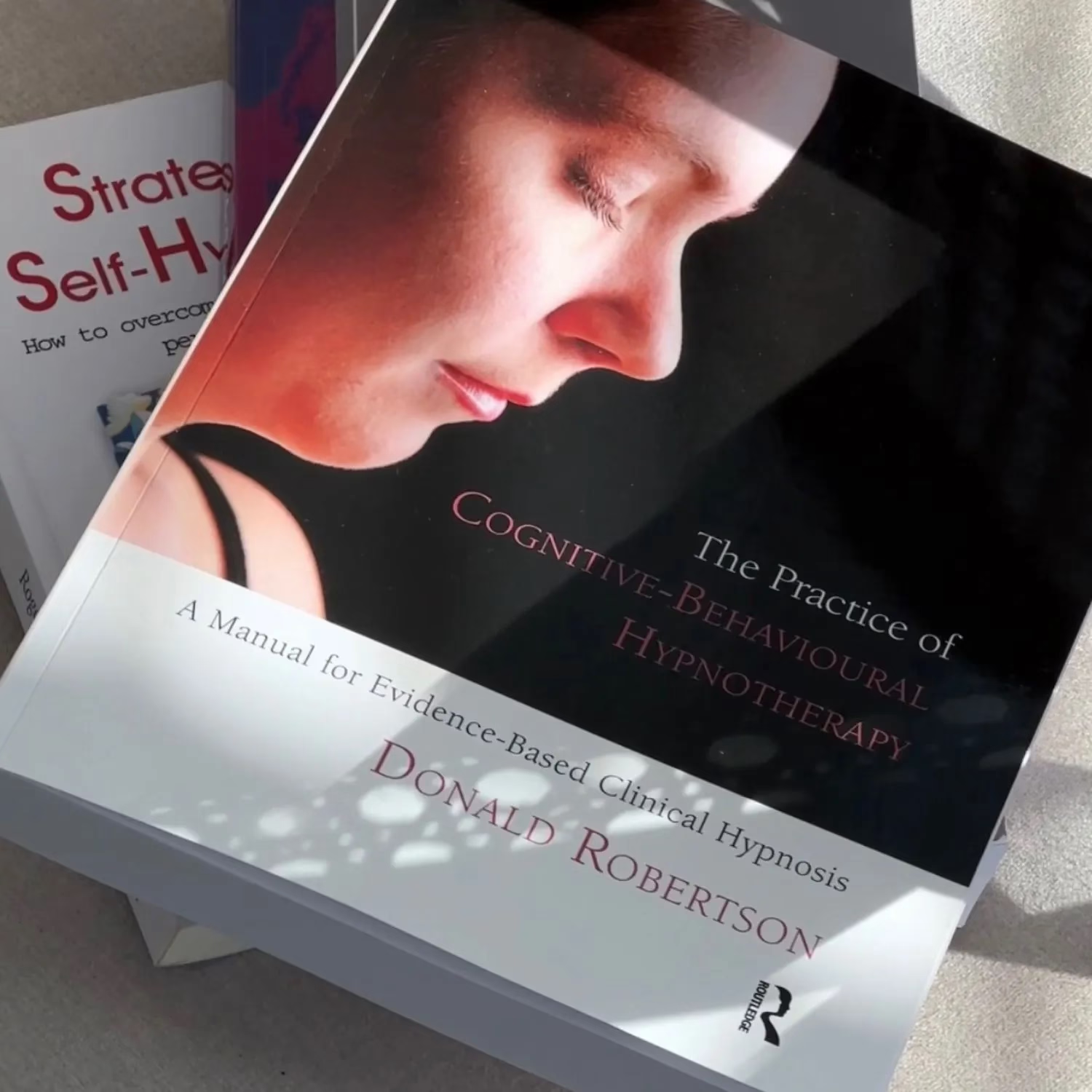
- The Practice of Cognitive-Behavioural Hypnotherapy (2013) by Donald Robertson – about £50
- Essentials of Clinical Hypnosis: An Evidence-Based Approach (2006) by Lynn and Kirsch – currently out of print but available on Kindle, for about £30
We’d also strongly recommend:
Conditioned Reflex Therapy by Andrew Salter – about £15
Strategic Self-Hypnosis by Roger Strauss PhD – about £15
Yes – you are welcome to have a free phone consultation with a member of our team if you would like some clarity on whether the Cognitive Behavioural Approach and the Online Diploma format are the right fit for you. If you’re committed to shifting to a career that’s more aligned with your life values or expanding your existing therapeutic practice to create deeper client change, talking directly to a member of our team can be a very helpful part of your decision-making process.
Click here to book a call with a Course Advisor. To schedule a call, email enquiries@hypno-cbt.com or call us directly on 020 7112 9040.
Questions about Accreditation and Practice
Once you have completed all three stages of the Diploma content and the assessment, you will receive your certificate of achievement. This qualification has been accredited by NCFE under the Customised Qualification, and the certificate of achievement will be issued directly by NCFE.
Once qualified at Level 5, you can upgrade your membership with NCIP, and upgrade your student insurance to full professional insurance. At this stage, you can start to treat clients for payment.
Our complete hypnotherapy Diploma training programme is approved by a range of UK, international and US professional bodies, including the British Psychological Society, NCIP, NCH, and GHR. See our Course Accreditation page for the complete list of registers and accrediting bodies.
By taking the online training and completing the required Case Studies and written assessment, you will receive exactly the same qualification as the live classroom training: our Level 5 Higher Diploma in Cognitive Behavioural Hypnotherapy – a Customised Qualification verified and awarded by NCFE, a government-regulated awarding organisation. Please note this is an unregulated qualification and is not a nationally recognised qualification.
You will be able to join professional membership registers, obtain insurance and open your practice.
This training course is also approved by the British Psychological Society Learning Centre as appropriate CPD for professionals, and accredited by the National Council of Integrative Psychotherapists – upon obtaining the Level 5 Higher Diploma you will be able to join NCIP as a full member.
The Online Diploma training is also accredited or accepted for membership by several other professional hypnotherapy organisations, including FHT, ACCPH and REBHP. FHT is the UK’s largest professional association for therapists. See our Course Accreditation page for the full list.
As experienced educators and trainers, we gave ourselves the remit to design an online course that matched the level of training of the live classroom Diploma. We are very excited that we can now offer aspiring hypnotherapists worldwide a qualification to start practising and helping others change.
The NHS do not recognise hypnotherapy diplomas. The Diploma is officially mapped against the National Occupational Standards for Hypnotherapy published by Skills for Health, and correlated with the NHS Key Skills Framework. It is, however, currently unusual for clients receiving hypnotherapy to be funded by the NHS – although some hypnotherapists have arranged this.
Note: some hypnotherapists develop a good relationship with local GPs and consultants who may recommend hypnotherapy for their patients. The evidence-based approach and the integration with CBT should make hypnotherapists trained in our approach more likely to receive referrals from GPs and other health professionals.
Most hypnotherapy clients self-refer and pay for their own treatment privately.
The majority of our graduates set up in private practice once they have completed their diplomas and obtained professional insurance. You can hear from some of our graduates in Career in Hypnotherapy webinar, and on our Youtube channel. You can also read more about our graduates and their outcomes here.
Yes. Starting your own therapy practice can be a daunting prospect, especially if you have never been self-employed or started your own business before. We provide as much support as we can to Diploma students both during and after their training.
You will get one year’s free membership to the Hypno-CBT® Professional Membership Hub: an online platform for current students and alumni to support them on their journey to becoming successful cognitive-behavioural hypnotherapists, as well as continually developing as therapists once set up in practice. A key feature of the hub is the regular business-based sessions.
These include a monthly Walk-in Business Surgery Session with business-building expert Mark Austin, monthly “Setting up your business” sessions with Celia Griver, featuring different experts and advisors, and monthly Social Media sessions with Harriet Curry. Details of these sessions can be found here.
Yes. All practising hypnotherapists should have a clinical supervisor, whose role is to continually mentor and support you in direct relation to your practice with clients. Hypno-CBT® College has a list of approved supervisors. Also certain professional registers such as NCH and GHR maintain a database of approved supervisors and will provide members with support in finding a suitable supervisor.
Questions about hypnotherapy generally
With regard to hypnotherapy being available on the NHS – here are some links to answer that question (it’s a complex issue – hypnotherapy is recognised by much of the NHS, but the NHS is not a monolith, and hypnotherapy is not easily available). Learn more about hypnotherapy on the NHS here.
And again from the Royal College of Psychiatrists here.
“Hypnotherapy is not usually available on the NHS, but NHS psychologists and therapists trained in hypnotherapy may be locally available. Many therapists use hypnotherapy to make other therapies like CBT more effective.”
Some in the NHS do offer it, read more here.
NHS on Hypnosis and Cancer Support, University Hospital of Southampton here.
And this article is also helpful.
If you have any questions about our training courses and how to become a hypnotherapist, or if you would like to request a prospectus, please feel free to contact us.