
THE MODEL EXPLAINED
What is Hypno-CBT®?

What is Hypno-CBT®?
If you’re new to Hypno-CBT®, see our full explanation of what it is first. Here, we go deeper into the model itself, how it’s built, how it differs from other approaches to cognitive-behavioural hypnotherapy, and why we teach it the way we do on the Diploma.
Not the only model of its kind
Just to be clear from the outset, there are several different models of cognitive-behavioural hypnotherapy. Some are fairly basic: CBT, with some relaxation hypnosis added on. Others are more sophisticated: the late Dr Assen Alladin, for instance, combined a “dissociation” model of hypnosis with CBT interventions, and ran a randomised control trial comparing CBT for depression with CBT+hypnosis for depression.
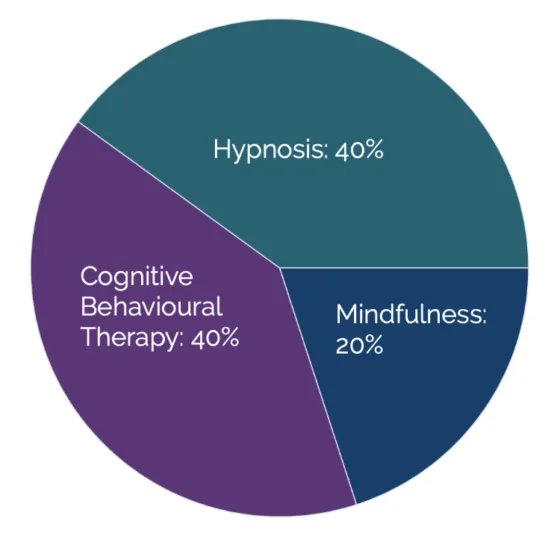
The Hypno-CBT® model is a seamless integration of social, cognitive and behavioural psychology and psychotherapy with a modern approach to hypnosis, giving therapists real skill and flexibility in how they use hypnosis, grounded in strongly supported mainstream psychological theory.
What “cognitive-behavioural” means here
This shows up in three ways:

The way we understand hypnosis itself is cognitive-behavioural
About attention, focus, expectation and motivation, not “being put into a trance.”

The way we conceptualise client problems is cognitive-behavioural
Focused on what’s maintaining the problem in the present moment. A phobia, for example, is understood as fearful beliefs activating strong emotions that lead to avoidance, and the avoidance is what prevents the person ever learning the feared thing isn’t dangerous.

The interventions themselves are cognitive-behavioural
New ways of thinking, letting go of unhelpful thoughts, relaxation, problem-solving, graded approach to feared situations, assertiveness, with hypnosis added throughout to make each of these more effective. Hypnosis isn’t used to “access the unconscious” or free some hidden block, that isn’t a cognitive-behavioural technique.
What “integrative” means here
When we say that the Hypno-CBT® method is “integrative”, we also mean in three ways:

Hypnotherapy and CBT are integrated seamlessly
Not delivered as separate stages, we’ve developed specific techniques to achieve this.

Hypnosis and mindfulness sit on a spectrum
A client’s problems are often understood as a form of negative self-hypnosis, believing and responding to negative automatic thoughts as though they were true. Therapy involves helping the client “dehypnotise” from those thoughts, and then focus on and imagine more helpful ones.

We aim for integrated functioning of emotion, thought and action
Healing the split between them, so what someone feels, thinks and does moves in the same direction, in a way that’s functional for them.
Why the evidence matters for training
Modern interest in integrating hypnotherapy with CBT dates back to an influential 1995 meta-analysis by Kirsch, Montgomery and Sapirstein, which drew on 18 randomised controlled trials and found that for between 70-90% of clients, cognitive and behavioural therapies were more effective when integrated with hypnosis (Kirsch et al., 1995).
Over thirty years on, Ramondo et al. (2021) published an updated meta-analysis pooling 48 controlled studies and 1,928 participants, each comparing CBT with CBT+hypnosis. The results broadly supported Kirsch’s earlier findings: 66% of participants experienced better outcomes than their CBT-only counterparts post-treatment, rising to 72% at follow-up (Ramondo et al., 2021).
This general evidence for combining hypnosis with CBT is part of why we teach the model the way we do – though the studies above test hypnosis added to CBT broadly, not the specific integrated Hypno-CBT® model taught on this Diploma.

How we teach CBT on the Diploma
Rather than a manualised approach, we teach from CBT principles – the fundamentals of the CBT mindset, and how to apply that flexibly and creatively when designing treatment. This reflects the direction we think CBT itself is heading: a focus on process, not just protocol.
We particularly emphasise CBT approaches that are simple to learn, well-evidenced, and broadly applicable, including multi-modal therapy, systematic desensitisation and imaginal exposure, stress inoculation training, and problem-solving therapy. We don’t just add hypnosis to these; hypnosis is integrated into every part of them.
Our take on CBT also draws on some influences less commonly seen in traditional CBT training: the role of language and thought (Vygotsky, Meichenbaum), the function of tension in the skeletal musculature, the relationship between facial tension and thought, and the therapeutic aim of “disinhibiting” the nervous system, alongside, of course, the hypnotic impact of language and imagery.

Ready to start your Hypno-CBT® journey?
Book a discovery call with our admissions team and find the right pathway for you.
references
- Kirsch, I., Montgomery, G., & Sapirstein, G. (1995). Hypnosis as an adjunct to cognitive-behavioral psychotherapy: A meta-analysis. Journal of Consulting and Clinical Psychology, 63(2), 214–220.
- Ramondo, N., Gignac, G. E., Pestell, C. F., & Byrne, S. M. (2021). Clinical hypnosis as an adjunct to cognitive behavioural therapy: An updated meta-analysis. International Journal of Clinical and Experimental Hypnosis, 69(2), 169–202.