
For psychology graduates, students and assistant psychologists
Put your psychology degree to work with clients
Hypno-CBT® is a cognitive-behavioural psychotherapy that uses hypnosis within a CBT framework. The Diploma is typically completed within 12 months and is most often used to set up ethical, well-defined private practice.
- Level 5 Higher Diploma, externally verified and awarded by NCFE
- Approved through the BPS CPD Quality Mark Scheme for the purposes of continuing professional development
- Study live online or at your own pace, with one-to-one tutoring
Prefer to watch first? See the session with Mark R. Davis and Dr Krissie Ivings ↓
BPS CPD Quality Mark
Continuing professional development
NCFE Customised Qualification
Benchmarked at Level 5
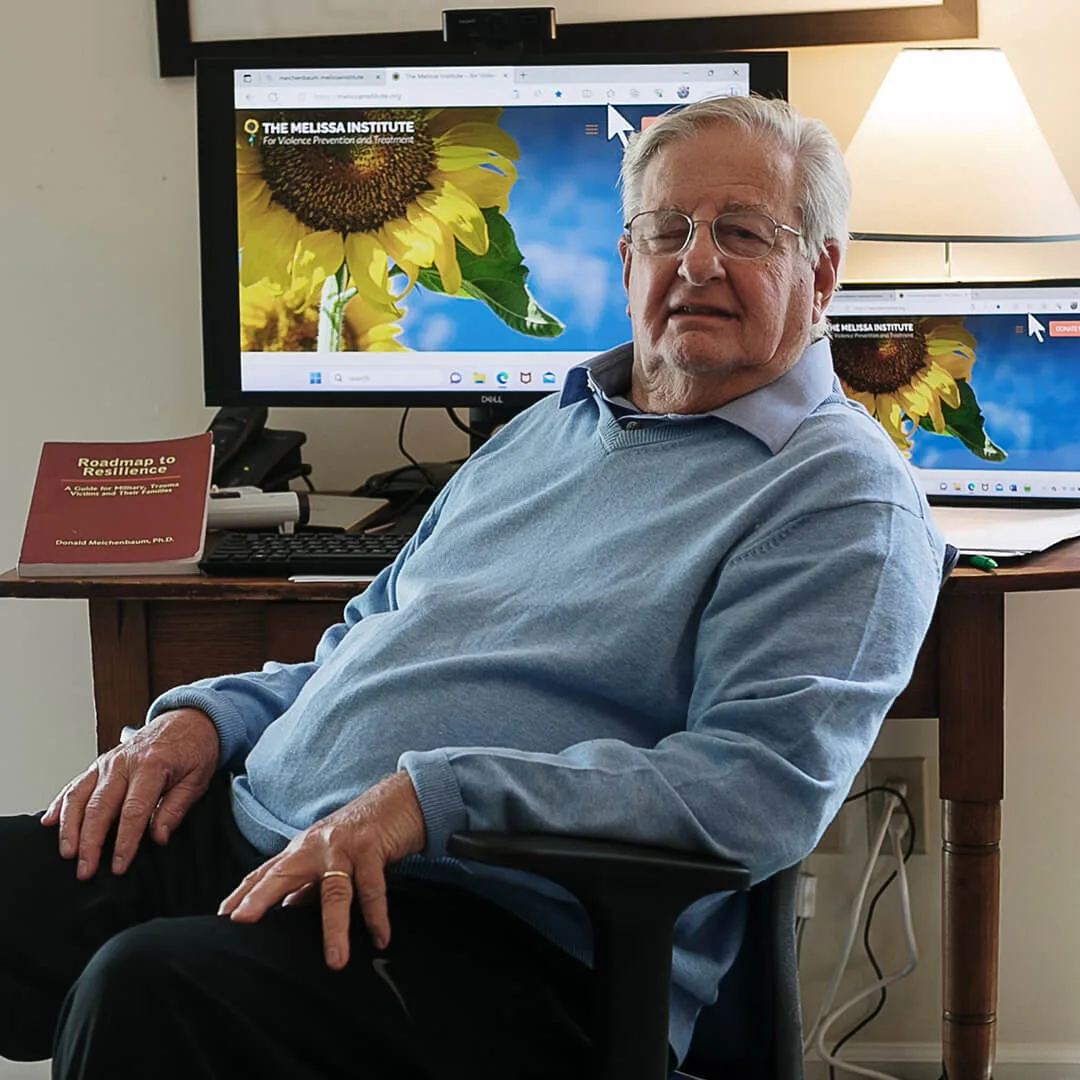
Prof. Donald Meichenbaum
Chairs our Senior Advisory Board
Risk-Free Start Guarantee
Start the training, then decide
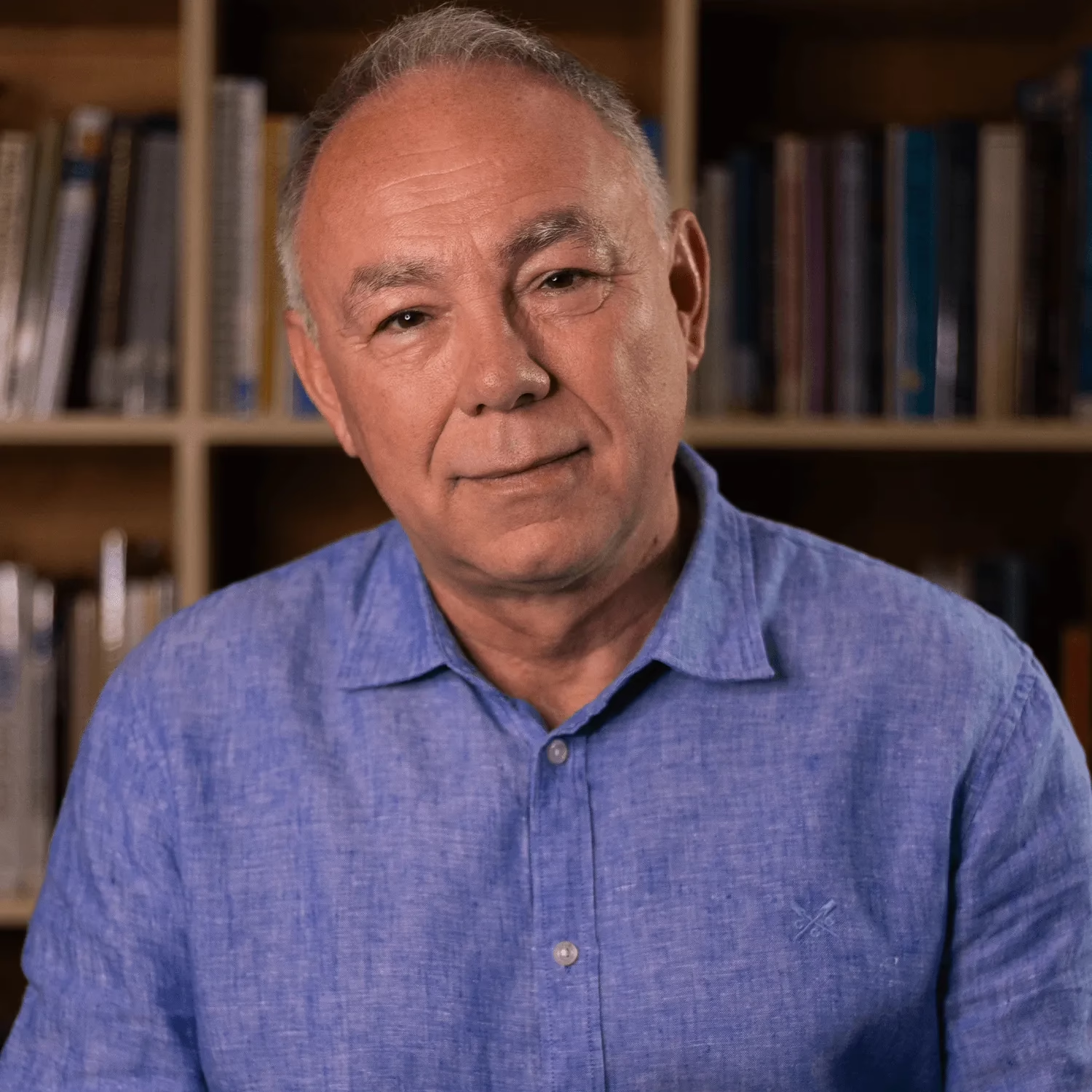
Mark R. Davis
BSc (Psy & Phil), GMBPsS, FRSM · Principal, Hypno-CBT® College
A note from our Principal
If you studied psychology to help people change, the route into practice can feel narrow
The DClinPsy matters, and it’s what many of us hoped for. It isn’t the only way into applied therapeutic work. Counselling psychology, PWP and high-intensity CBT training, research roles and assistant posts all come with different costs, timescales and limits.
Hypno-CBT® is another option. This page sets out what it involves, how long it takes and where it fits, so you can weigh it up against the others.
Weigh up the options
How the routes compare
Rough figures for the main routes into therapeutic work in the UK. Each route leads to a different scope of practice and different settings, so time and cost are only part of the decision.
| Route | Qualification level | Typical time to practise | Training cost (est.) | Personal therapy required |
|---|---|---|---|---|
| Hypno-CBT® Diploma | Level 5 | 7–12 months | £5,972 | Not required |
| Counselling | Level 4–5 | 3–4 years | £10k–£15k | Yes (est. £1.5k–£3k) |
| Psychotherapy | Level 5–7 | 4–7 years | £20k–£35k | Yes (est. £5k–£10k) |
| Counselling psychology | Level 8 (doctorate) | 6–8 years | £60k–£80k | Yes (est. £6k–£8k) |
| Clinical psychology | Level 8 (doctorate) | 6–9 years | NHS-funded place | Optional |
Times include training before independent practice. Costs exclude living expenses.
What Hypno-CBT® involves
Where CBT and hypnosis overlap
Hypno-CBT® is cognitive-behavioural in three specific ways, with hypnosis built into each one.
If you know Beck, Wells, Meichenbaum, Wolpe, Jacobson, Hayes and Kabat-Zinn, you already know the foundations we build on.
CBT
Hypnosis
Hypno-CBT®
01
How hypnosis is understood
As focused attention, expectation, motivation and imaginative absorption. There’s no special trance state involved, and the work doesn’t rely on a Freudian unconscious.
02
How problems are understood
Anxiety, phobias and avoidance are formulated by what keeps them going now, using the same models you met in your degree.
03
What you do with clients
Teach new ways of thinking, approaching instead of avoiding, regulating emotion and solving problems. Hypnosis and mindfulness help clients rehearse those skills vividly.
What is Hypno-CBT®? · Hypno-CBT® and modern neuroscience · The toolbox of 35 interventions
What the research says
Does hypnosis add anything to CBT?
Two meta-analyses have compared CBT on its own with CBT combined with hypnosis. Both found that adding hypnosis improved outcomes on average.
Hypno-CBT® explained · The research
Hypnosis gives CBT an edge that grows over time
Two big reviews, 26 years apart, found hypnosis improved CBT’s results. The newer one found the gap wider at follow-up.
The gap between the two groups
At the end of treatment
66%
At follow-up
72%
What % means
The share of people who had hypnosis added to CBT who did better than the average person who had CBT alone.
The first big review
1995
Kirsch and colleagues combined 18 studies. The average client given hypnosis did better than at least 70% of those treated without it.
the addition of hypnosis substantially enhanced treatment outcome
The update
2021
Ramondo and colleagues combined 48 comparisons (1,928 people). In the higher-quality studies: 66% after treatment, 72% at follow-up.
an enhancer of CBT’s efficaciousness and endurance as a treatment
Hypno-CBT® draws on this evidence: hypnosis used inside an evidence-based therapy.
Kirsch, I., Montgomery, G. & Sapirstein, G. (1995). J Consult Clin Psychol, 63(2), 214–220 · Ramondo, N., Gignac, G. E., Pestell, C. F. & Byrne, S. M. (2021). Int J Clin Exp Hypn, 69(2), 169–202 · Percentages: Ramondo et al., higher-quality studies.
These studies looked at CBT combined with hypnosis in general. They weren’t trials of Hypno-CBT® itself.
The detail, for those who want it
Ramondo et al. (2021) pooled 48 comparisons at post-treatment (N = 1,928) and 25 at follow-up (N = 1,165), and report Cohen’s d of .25 to .41 at post-treatment and .54 to .59 at follow-up. The percentages convert d into how the two groups overlap: 50% would mean hypnosis added nothing. Gains after treatment were clearest for low mood and pain, and the follow-up advantage was strongest for weight loss. The 1995 weight-loss results were re-analysed in 1996 (Allison & Faith), which found a smaller effect for that subset.
Sources: Ramondo et al. (2021), International Journal of Clinical and Experimental Hypnosis, 69(2) · Kirsch, Montgomery & Sapirstein (1995), Journal of Consulting and Clinical Psychology, 63(2).
Watch first
Watch the session with Mark R. Davis and Dr Krissie Ivings
Recorded for psychology graduates, assistant psychologists and DClinPsy applicants. Mark and Krissie talk through the pathway, the evidence and what the training can and can’t offer.

What it covers
- Why the psychology career pathway can become narrow
- What Hypno-CBT® is, and what it isn’t
- What the evidence says about adding hypnosis to CBT
- How the Diploma works as a vocational route into private practice
- How to judge whether it fits your background and goals
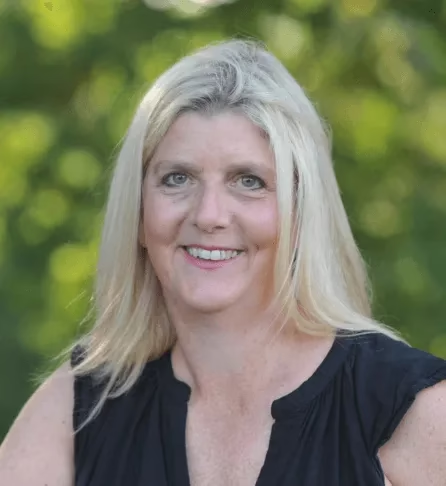
A clinical psychologist who trained with us
Dr Krissie Ivings
DClin, BABCP Acc. · Consultant Chartered Clinical Psychologist, HCPC registered · Head of the Hypno-CBT® Research Unit
- Over 25 years in the NHS and independent practice.
- Former Head of Psychology for a large NHS Trust (CAMHS).
- NHS England Clinical Lead on several large-scale transformation programmes, including specialised community eating disorder services and crisis care across Greater Manchester.
- Primary author of the Greater Manchester crisis care pathway for children and young people (REACH-IN, 2018) and The SPIRAL Manual (2023), a model of care for looked-after children.
- Clinical Director of Aspire Therapy Services, commissioned by the NHS and local authorities to support children and young people in care.
- A Dialectical Behaviour Therapy (DBT) specialist. She trained with the College because of its adherence to the evidence base, and now uses Hypno-CBT® in almost all of her work.
“Hypno-CBT® allows clients to safely experience positive changes in their imagination before committing to action. This training transformed cognitive and behavioural therapy protocols I used in practice into dynamic, enjoyable processes, leading to faster and better clinical outcomes.”
Krissie on how Hypno-CBT® changed her therapy practice

More about Krissie · Her full interview with Mark R Davis
Hypno-CBT® Senior Advisory Board
Professor Donald Meichenbaum chairs the Hypno-CBT® Senior Advisory Board
Professor Donald Meichenbaum, PhD
Distinguished Professor Emeritus, University of Waterloo, Canada · Research Director, Melissa Institute for Violence Prevention, Miami
- Recognised, with Albert Ellis and Aaron Beck, as one of the founders of cognitive behavioural therapy. He developed Self-Instructional Training and Stress Inoculation Training.
- Voted one of the ten most influential psychotherapists of the twentieth century in a survey of clinicians reported in the American Psychologist.
- We helped record, edit and publish his legacy course series, The Essence of Psychotherapy, in which he shares 50 years of clinical wisdom.
About Professor Meichenbaum · Senior Advisory Board
“The version of hypnosis this College teaches sits on the same root: not a mysterious trance, but focused attention and believed-in imagining, the very ground from which my own work on self-instruction grew.”
“I am encouraged to see Hypno-CBT® develop as a transdiagnostic, process-based approach that takes seriously the factors the outcome research tells us matter most, including the cultivation of expectancy and hope.”
Professor Donald Meichenbaum, Chair of the Hypno-CBT® Senior Advisory Board
The training
The Higher Diploma in Cognitive Behavioural Hypnotherapy
Structured teaching in three stages, with supported, practical learning throughout.
Stage 1
Evidence-Based Hypnosis
Build core skills in hypnosis, suggestion, self-hypnosis and the therapeutic relationship.
Stage 2
Behavioural Hypnotherapy
Integrate hypnosis with behavioural approaches, helping clients practise new responses and change unhelpful patterns.
Stage 3
Cognitive Hypnotherapy
Work with thoughts, beliefs and assumptions, integrating cognitive methods with hypnosis and imagery.
Three strands, taught together
Clinical expertise
A toolkit of 35 evidence-based techniques, case formulation, and clear guidance on scope of practice and when to refer on.
Personal growth
Structured mindset work, including an inventory of limiting professional beliefs, so self-doubt doesn’t hold you back once you qualify.
Business skills
The 6F-9P business and marketing framework for therapists. You finish with a business plan, a financial plan and a Directory listing.
Support as you learn
- Personal tutoring: 6 hours on the live webcast, 18 hours online.
- Live supervised practice sessions, currently four times each week.
- Digital teaching materials, exercises, scripts and forms.
- The Hypno-CBT® Helix, connecting clinical skills, personal growth and business development.
- 12 months of the Professional Membership Hub.
Two ways to study
Live webcast
Taught online in real time across three intensive stages, with trainer interaction, peer learning and live practice. Join from anywhere.
Online, at your own pace
Recorded teaching, tutor support and 18 hours of one-to-one coaching from a qualified Hypno-CBT® practitioner. Starts on the 1st of each month.
Both lead to the same Diploma and the same NCFE certificate of achievement.
The qualification
On successfully completing the required training and assessment, you gain the Level 5 Higher Diploma in Cognitive Behavioural Hypnotherapy (Hypno-CBT®). It is accredited by NCFE as a Customised Qualification and benchmarked at Level 5. NCFE is an awarding organisation recognised by the qualification regulators for England (Ofqual), Wales (Qualifications Wales) and Northern Ireland (CCEA Regulation). This is an unregulated qualification and is not a nationally recognised qualification. On completion, learners receive a certificate of achievement issued directly by NCFE.
All formats of the Hypno-CBT® Diploma are approved through the BPS CPD Quality Mark Scheme for the purposes of continuing professional development.
Accreditation · The full programme
Fees and dates
What it costs, and when you can start
Diploma fee, paid in full
£5,972
BPS members
10% off tuition
Payment plans and full terms are on the fees page.
Next live webcast starts
Training days run 10:00 to 18:00 UK time. Each stage has two parts, and you attend all three stages.
January to March 2027
| Stage | Part 1 | Part 2 |
|---|---|---|
| 1 | Fri 15 to Sun 17 Jan | Sat 23 to Mon 25 Jan |
| 2 | Thu 4 to Sun 7 Feb | Thu 11 to Sat 13 Feb |
| 3 | Thu 25 to Sat 27 Feb | Wed 3 to Sat 6 Mar |
Prefer your own pace? The online Diploma starts on the 1st of each month. About the online Diploma
Start with confidence
Experience the training before you decide
Under the Risk-Free Start Guarantee, if you decide the Diploma is not right for you within the guarantee period, tell us in writing and we refund 100% of your course fee.
Live webcast
The first three training days.
Online
Up to Module 3 or 30 days, whichever comes first.
Switching format
No core switching fees between online and live webcast stages.
From our graduates
★★★★★
“I particularly appreciated the evidence-based and practical nature”
Ian Boyle, 23 August 2026, Trustpilot
★★★★★
“structure, focus, and truly outstanding teaching”
Kimberley Green, 24 November 2025, Trustpilot
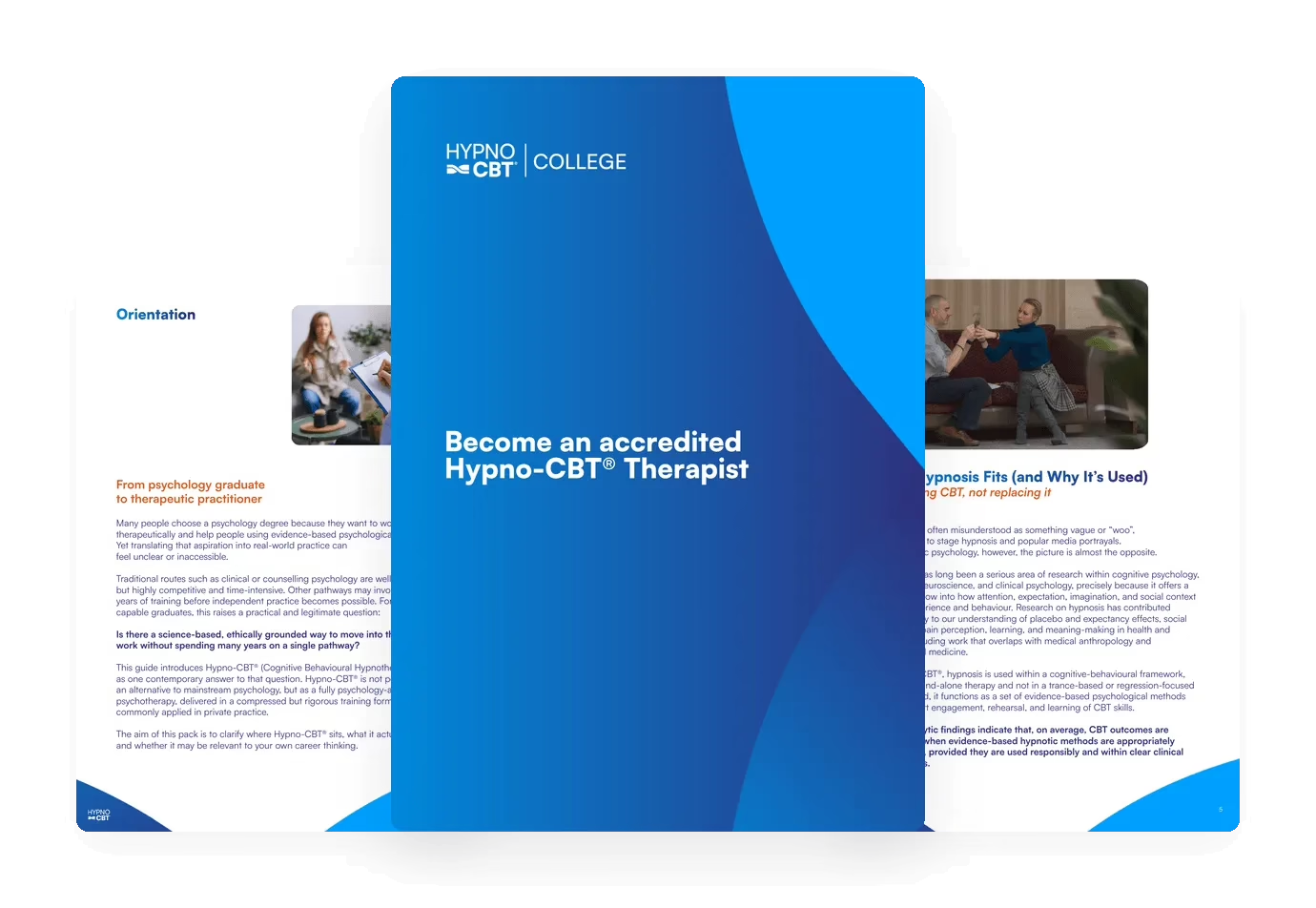
Free download
What’s in the career pack
- Where Hypno-CBT® sits within mainstream psychology
- How hypnosis is used within a CBT framework, and why
- How the training handles ethics, supervision and scope of practice
- The standards behind it: BPS CPD Quality Mark and NCFE Level 5
- Where practitioners apply it, from anxiety and habit change to chronic pain and IBS
Before you decide
Questions people ask
Do I need a psychology degree to train?
No. The Diploma is open to people from many backgrounds. If you’ve studied psychology, much of the theory will be familiar and you can put more of your attention on applying it.
Is this an alternative to clinical or counselling psychology?
It’s a separate route with its own scope. Hypno-CBT® practitioners most often work in private practice, within clear boundaries and with referral networks for anything outside their remit. Some qualified psychologists also train in it to add to their existing work. It does not lead to HCPC registration, or the protected title of psychologist. Hypnotherapy is not statutorily regulated in the UK.
How long does the training take?
Most people complete the Diploma within 12 months.
What qualification will I get?
A Level 5 Higher Diploma in Cognitive Behavioural Hypnotherapy, externally verified and awarded by NCFE. It’s a customised qualification benchmarked at Level 5, and on completion you receive a certificate of achievement issued directly by NCFE. This is an unregulated qualification and is not a nationally recognised qualification.
What does the fee include?
The three-stage training, digital course materials, personal tutoring for your format, supervised practice, the Hypno-CBT® Helix, the Level 5 assessment and 12 months of Professional Membership Hub access. After 12 months, Hub membership continues at £19.99 a month unless you cancel.
Is there a discount for BPS members?
Yes. BPS members get 10% off Diploma tuition fees. It can’t be combined with other offers.
What if I change my mind?
The booking terms set out cancellation rights, including a 14-day period from the Confirmation of Acceptance email. The Risk-Free Start Guarantee covers the first three live webcast days, or online study up to Module 3 or 30 days. Booking terms
Can I train from outside the UK?
Yes. Both the live webcast and the self-paced route are delivered online.
Rather talk it through first?
Book a short call with one of our course advisors. Tell us about your background and plans, and ask anything about the training, fees or what practice looks like afterwards.
Or email enquiries@ukhypnosis.com · call 020 7112 9040
Read more